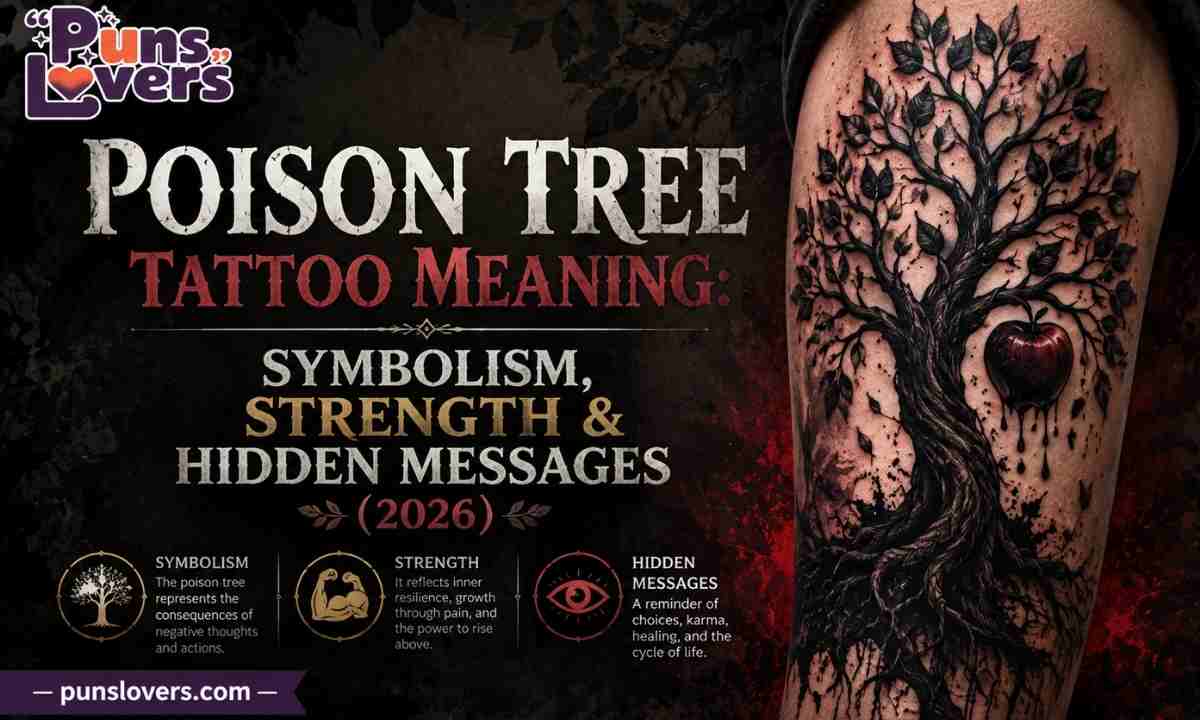
If you’ve ever felt anger you never said out loud, the poison tree tattoo meaning will probably hit close to home. This design isn’t just striking ink it’s a quiet confession about the emotions we bury instead of speak. Rooted in a 200-year-old poem, it’s become one of the most personal, story-driven tattoos people choose today.
In this guide, you’ll learn exactly where the symbol comes from, what it means for different people, and how to pick a design and placement that actually fits your story.
What Is a Poison Tree Tattoo?
A poison tree tattoo is a piece of body art built around a twisted, often leafless tree bearing a single glowing apple. It’s usually rendered in dark ink, sometimes with roots that dig deep into the skin like veins.
At its core, this tattoo represents suppressed anger that grows into something dangerous. It’s less about violence and more about what happens inside us when we swallow our feelings instead of expressing them.
Most people who get this tattoo aren’t trying to look edgy. They’re marking a lesson they learned the hard way usually about honesty, boundaries, or letting go of grudges before those grudges take root.
Quick answer: A poison tree tattoo symbolizes hidden anger, emotional growth, and the personal cost of staying silent about pain.
Unlike a lot of trendy tattoo symbols, this one isn’t chosen for shock value. It tends to attract thoughtful people writers, therapists, survivors of difficult relationships who want a design with real substance behind the linework. That’s part of why it keeps showing up in tattoo portfolios year after year, long after flashier trends fade.
You’ll also see it described as a “shadow work” tattoo in some wellness and therapy-adjacent spaces, since it visually captures the process of confronting the parts of ourselves we’d rather ignore.
The Meaning Behind William Blake’s A Poison Tree
The design traces back to “A Poison Tree,” a short poem written by English poet William Blake in 1794, published in his collection Songs of Experience.
The poem opens with a simple contrast. When the speaker is angry with a friend, he says so, and the anger fades. When he’s angry with an enemy, he hides it and that silence becomes the seed of something poisonous.
- He waters his hidden anger with fear and tears.
- He “suns” it with fake smiles and deceit.
- Over time, it grows into a tree that bears a single shining apple.
- His enemy steals the apple in the night and is found dead beneath the tree the next morning.
Scholars often connect this to the Genesis story of the Garden of Eden, where forbidden fruit leads to a fatal fall. You can read the full poem and its background on <cite index=”2-1″>Wikipedia’s entry on A Poison Tree</cite>, which remains one of the most cited academic sources on the piece.
The takeaway Blake leaves us with is simple but sharp: honesty defuses anger, while silence lets it grow into something that can hurt everyone involved including the person carrying it.
What makes the poem so tattoo-friendly is its rhythm. Blake wrote it with a simple, almost sing-song structure, which is part of why single lines from it read so naturally as tattoo text. Lines like “In the morning glad I see, my foe outstretched beneath the tree” carry weight on their own, even without the rest of the poem for context.
It’s also worth knowing that Blake wasn’t just a poet he was a printmaker and painter, and many of his works blend visual art with verse. That combination of image and language is likely part of why “A Poison Tree” translates so naturally into a visual tattoo design instead of staying purely as text on a page.
Literary tattoos tend to hold up well over time precisely because they’re tied to something with lasting cultural weight. A poem that’s been studied and referenced for over two centuries isn’t going anywhere, which gives this tattoo a kind of built-in timelessness that trend-based designs simply don’t have.
Poison Tree Tattoo Meaning
So what does it actually mean when someone puts this on their skin? The interpretations vary slightly, but a few core themes show up again and again.
- Suppressed emotion. A reminder to speak up before resentment festers.
- Personal transformation. Proof that someone survived a season of anger, betrayal, or heartbreak.
- A warning to self. A visual note-to-self not to let old wounds turn toxic.
- Poetic identity. Simply a love of Blake’s writing and classic literature.
For many people, it’s a mix of all four. The tattoo becomes a permanent checkpoint a way of saying, I know what happens when I don’t deal with my feelings, and I choose differently now.
It’s worth noting this tattoo rarely means someone wants to cause harm. Almost every account behind it points inward, not outward it’s about self-awareness, not revenge.
There’s also a timing element many people don’t think about at first. Some choose the tattoo during a hard season, as a way of processing what they’re feeling in real time. Others wait until they’re further along, using the design to mark the distance they’ve traveled since. Neither approach is more “correct” it just changes what the tattoo will mean when you look back at it years later.
A smaller but meaningful group gets this tattoo specifically to mark therapy milestones the moment they finally learned to name a feeling instead of swallowing it. In that context, the poison tree becomes less about the anger itself and more about the skill of catching it early, before it has the chance to take root.
Poison Tree Meaning and Symbolism
Beyond the tattoo itself, the poison tree carries layered symbolism worth understanding before you commit to the design.
| Symbol | What It Represents |
| The Tree | Anger or resentment that’s been left to grow unchecked |
| The Apple | Temptation, deceit, or a dangerous “reward” born from hidden feelings |
| The Roots | How deeply buried emotions can anchor themselves in us over time |
| The Garden | The private, inner world where these feelings are cultivated |
| The Night | Secrecy — emotions hidden from others and sometimes from ourselves |
Each element gives tattoo artists room to get creative. Some clients ask for bare, gnarled branches to emphasize decay. Others want a single glowing apple as the focal point, letting everything else fade into shadow.
Understanding this symbolism matters because it shapes how the tattoo will read to other people and to your future self, years down the line.
It’s also worth thinking about negative space when planning this tattoo. Because the tree’s power comes from what’s hidden underground the roots, the “night” the poem keeps returning to some of the best designs lean into shadow and unfinished lines rather than tight, clean detail. A little roughness in the branches can actually communicate the theme better than a perfectly symmetrical tree would.
If you’re working with a tattoo artist for the first time on a piece like this, it helps to bring reference images that show the feeling you want, not just the shape. Words like “withered,” “reaching,” or “hollow” often communicate more to an artist than a single photo reference alone.
Poison Tree Tattoo Meaning for Women
For many women, the poison tree tattoo becomes a symbol of reclaiming voice after periods of staying quiet in relationships, at work, or within family dynamics.
It often marks:
- Moving on from a toxic relationship or friendship
- Learning to set boundaries instead of absorbing conflict silently
- A personal vow to stop performing happiness she doesn’t feel
Design-wise, women often lean toward smaller, more delicate linework a slender trunk with fine roots, sometimes paired with a single red or black apple as a pop of contrast. Placement on the ribs, forearm, or behind the ear keeps the piece intimate rather than bold.
It’s rarely about anger toward another person. Most women describe it as a private symbol of growth, not a public statement about anyone specific.
Poison Tree Tattoo Meaning for Men
Men who choose this tattoo often connect it to themes of restraint and inner strength the idea that real power lies in choosing when and how to express anger, rather than reacting impulsively.
Common associations include:
- Overcoming a period of grief, betrayal, or long-held resentment
- A reminder to communicate directly instead of bottling things up
- An appreciation for classic poetry and literary symbolism
Bolder blackwork styles are popular here thick trunks, exposed roots, and heavy shading across the forearm, chest, or upper back. Some men pair the tree with additional imagery, like a raven or a skull, to deepen the theme of mortality and consequence.
Poison Tree Tattoo Meaning and Strength
At first glance, “poison” and “strength” might seem like opposites. But this tattoo is often chosen specifically because it represents strength gained through hard-won self-awareness.
Here’s the logic many people describe:
- They recognize a pattern of suppressing anger.
- They live through the consequences of that silence.
- They choose a healthier way forward.
- The tattoo becomes proof of that turning point.
In that sense, the poison tree isn’t a celebration of toxicity it’s a monument to change. It says: I understand my own capacity for resentment, and I’ve chosen not to let it define me.
This is part of why the design resonates so widely. It doesn’t glamorize anger; it acknowledges it honestly, which is a much rarer thing to see in tattoo symbolism.
Simple Poison Tree Tattoo Meaning
Not everyone wants a large, detailed piece and the good news is the symbolism holds up beautifully in minimalist form.
A simple poison tree tattoo usually strips the design down to:
- A single-line tree silhouette, often no wider than a finger
- One small apple, sometimes just a dot of color
- Fine-line roots instead of a full root system
Even at this scale, the meaning doesn’t shrink. If anything, a minimalist version emphasizes the “quiet” side of the story the emotions that grow silently, out of sight, until they can’t be ignored anymore.
Simple versions are especially popular for first tattoos, wrist or ankle placements, and anyone who wants meaning without a large visual statement.
Poison Tree Tattoo Meaning in Modern Culture
Outside of poetry circles, the poison tree symbol has taken on a life of its own in modern tattoo culture. It shows up in:
- Music and lyric references where artists nod to Blake’s themes of hidden rage
- Book and literature tattoos, often paired with quotes from Songs of Experience
- Mental health awareness spaces, where it’s used to talk about emotional suppression and healing
Part of its staying power is how quotable the poem is the line “I was angry with my friend; I told my wrath, my wrath did end” is short enough to tattoo alongside the tree itself, giving the piece built-in context.
It’s also gained traction simply because it looks good. The image translates cleanly into fine-line, blackwork, and neo-traditional styles, which keeps it circulating across tattoo inspiration boards and portfolios year after year.
There’s also a growing overlap between poison tree tattoos and the broader “dark academia” aesthetic a style built around classic literature, muted colors, and old-world imagery. Since Blake’s poem fits so naturally into that world, the tattoo has picked up a second audience beyond people drawn purely to its emotional meaning: readers and literature lovers who simply appreciate the poetry behind the ink.
At the same time, therapists and mental health writers have started referencing the poem in articles about emotional regulation, which has introduced the symbol to an audience that may never have read Blake otherwise. It’s a good example of how old literature can find new relevance simply by staying honest about something timeless the way we handle anger.
Poison Tree Tattoo Meaning on Reddit
On tattoo-focused Reddit communities, people asking about this design tend to fall into two camps.
The first group is looking for artistic advice line weight, placement, how to keep small details from blurring over time. The second group is drawn to the story behind it, often sharing their own version of “the friend vs. foe” lesson from Blake’s poem.
A recurring theme in these discussions is reassurance: most commenters clarify that the tattoo isn’t dark or threatening, it’s reflective. It tends to attract people who’ve done real emotional work and want a permanent reminder of what they learned.
If you’re researching designs, tattoo subreddits are a solid place to see real placements and healed results before booking your own appointment.
Poison Tree Tattoo Meaning on Urban Dictionary
Slang-definition sites like Urban Dictionary occasionally reference “poison tree” in a broader sense describing a person, relationship, or situation that looks appealing on the surface but causes harm the longer you’re involved with it.
This isn’t a tattoo-specific definition, but it does echo the same core idea as Blake’s poem: something that looks tempting can still be rooted in something toxic.
When people bring this meaning into their tattoo choice, it usually reflects a personal experience walking away from a relationship, job, or environment that seemed fine on the outside but wasn’t healthy underneath.
Poison Tree Tattoo Meaning on X (Twitter)
On X, the poison tree symbol pops up most often in poetry appreciation posts, tattoo reveal threads, and short reflections on anger, forgiveness, or emotional growth.
Posts tend to pair a photo of the finished tattoo with a short caption referencing Blake or simply describing what the piece means to the person wearing it. It’s a natural fit for the platform’s short-form, personal storytelling style.
As with Reddit, the tone is rarely negative. Most posts frame the tattoo as a milestone evidence of choosing honesty over silence going forward.
Common Poison Tree Tattoo Designs and Their Meanings
There’s no single “correct” way to draw a poison tree tattoo. Here are the most requested variations and what each one tends to represent.
| Design Style | Typical Meaning |
| Bare, gnarled tree with no leaves | Anger stripped down to its rawest form |
| Tree with a single glowing apple | Focus on the “reward” of resentment temptation and consequence |
| Roots shown breaking through skin/ground | Deep-rooted or long-held emotional pain |
| Tree paired with a poem excerpt | Literary appreciation and direct storytelling |
| Tree with a raven or crow | Mortality, warning, or watchfulness |
| Blooming tree with new leaves | Healing and moving past old resentment |
Choosing between these often comes down to where you are in your own story. A bare, twisted tree suits someone still processing pain, while a version with new growth fits someone further along in healing.
Style options worth discussing with your artist:
- Fine-line: Best for smaller, detailed roots and delicate branch work.
- Blackwork: Heavier shading, ideal for larger placements like the back or thigh.
- Neo-traditional: Bolder outlines with limited color, good for the apple as a focal point.
- Illustrative/sketch style: Loose, hand-drawn lines that emphasize the “wild” feeling of an untended tree.
Whichever style you land on, ask to see healed photos of your artist’s past tree tattoos specifically. Fine root and branch details are some of the first things to blur if a design isn’t sized or spaced correctly, so experience with this exact subject matters more than general skill alone.
Poison Tree Tattoo Placement Ideas
Placement changes both the visibility and the feel of this tattoo. Here’s a quick breakdown to help you decide.
| Placement | Best For |
| Forearm | Bold statement pieces, easy to show or cover |
| Ribs | Private, deeply personal meaning |
| Back or spine | Larger, detailed designs with roots and branches |
| Behind the ear / wrist | Minimalist, single-line versions |
| Upper arm / shoulder | Balanced size, works well with blackwork shading |
| Ankle | Subtle placement, popular for first tattoos |
If this is a meaningful, story-driven tattoo for you, consider placement somewhere you’ll see it often a daily reminder tends to matter more than a highly visible one.
Size matters just as much as location. A detailed piece with visible roots and branch texture needs enough space to breathe cramming that level of detail onto a small wrist or finger often causes the linework to blur within a few years. If you love the intricate version but want a smaller placement, talk to your artist about simplifying the design rather than shrinking it as-is.
It’s also worth considering how the area ages and stretches. Ribs, inner arms, and areas near joints tend to shift more over time than flatter areas like the outer forearm or upper back, which can subtly change how fine linework looks a decade down the road.
Color Symbolism in Poison Tree Tattoos
Color choice can shift the entire feel of a poison tree tattoo, even with the same basic design.
| Color | Symbolic Meaning |
| Black / grayscale | Classic, somber tone — emphasizes anger and shadow |
| Deep red apple | Passion, danger, or unresolved emotion |
| Green accents | Growth, healing, or a story of overcoming resentment |
| Purple tones | Mystery, introspection, transformation |
| Muted earth tones | Grounded, natural, understated symbolism |
Most people choose black and gray for this design since it matches the poem’s somber tone, but a single color accent usually on the apple is a popular way to draw the eye without overwhelming the piece.
Keep in mind that color tattoos generally require more touch-ups over time than black and gray work, since colored ink tends to fade faster under sun exposure. If you’re set on a colored apple as your focal point, ask your artist about placement choices that stay covered most of the year, or plan on a touch-up every few years to keep the contrast sharp.
Should You Get a Poison Tree Tattoo?
This tattoo isn’t for everyone, and that’s okay. Ask yourself a few honest questions before booking:
- Do you connect with the theme of suppressed anger and honesty, or do you just like the visual?
- Are you comfortable explaining the meaning if someone asks?
- Does the placement fit your lifestyle and comfort with visibility?
- Have you researched an artist experienced in fine-line or blackwork tree designs, since detail work like roots and branches takes real skill?
If the meaning genuinely resonates with your own story, this tattoo tends to age well emotionally it’s not a trend piece, it’s closer to a personal milestone. If you’re only drawn to the aesthetic, that’s valid too, but it’s worth knowing the deeper story before it becomes permanent.
Read William Blake’s original poem “A Poison Tree”
A few practical steps can also make the process smoother:
- Sketch or save reference images that capture the tone you want withered versus blooming, minimal versus detailed.
- Talk placement and size together, since one heavily influences the other for a design with fine roots and branches.
- Ask your artist about longevity, especially if you’re leaning toward color or very fine linework.
- Sit with the decision for a few weeks if you can. Meaningful tattoos like this one tend to feel even more right after the initial excitement settles.
At the end of the day, the best poison tree tattoo is the one that matches your version of the story not a copy of someone else’s healed photo on social media.
For more design inspiration rooted in nature and symbolism, check out our related guide on tree tattoo meanings and symbolism for additional context before your appointment.
Frequently Asked Questions
What does a poison tree tattoo symbolize?
It symbolizes suppressed anger that grows over time, based on William Blake’s poem about the danger of hiding resentment instead of expressing it.
Is the poison tree tattoo based on a real poem?
Yes. It comes from “A Poison Tree” by William Blake, published in 1794 as part of Songs of Experience.
Does a poison tree tattoo mean something negative?
Not usually. Most people get it as a reminder to communicate honestly, not as a symbol of wanting to harm others.
Where is the best placement for a poison tree tattoo?
Forearms and the back suit larger, detailed designs, while wrists or ribs work well for smaller, more private pieces.
Can a poison tree tattoo be minimalist?
Absolutely. A single-line tree with one small apple keeps the meaning intact while fitting almost anywhere on the body.
Is this tattoo popular for both men and women?
Yes. Men often lean toward bold blackwork versions, while women tend to prefer smaller, fine-line designs though styles vary by personal taste.
Should I add a quote with my poison tree tattoo?
It’s optional. A short line from Blake’s poem can add context, but the tree and apple carry the meaning on their own.
Conclusion
At the end of the day, a poison tree tattoo is really about honesty with others, and more importantly, with yourself. It’s a small, permanent reminder that feelings left unspoken don’t just disappear; they grow into something bigger.
Whatever design or placement you choose, let it reflect your own story, not just the trend. That’s what makes this tattoo and the lesson behind it worth carrying with you.

We are passionate about wordplay and spreading smiles through witty content. Backed by 5 years of experien . PunsLovers.com is your go-to hub for humor.