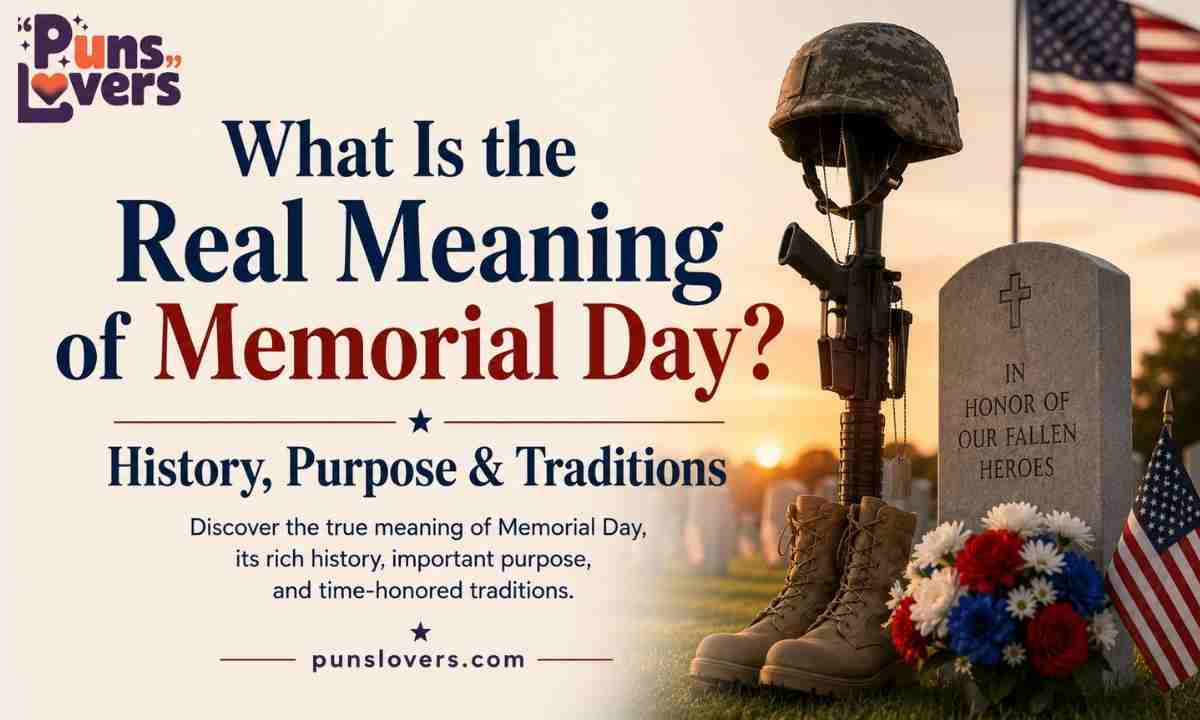
Every year at the end of May, Americans fire up the grill, head to the beach, and enjoy a long three-day weekend. Stores run sales. Roads fill with road-trippers. Social media lights up with summery photos.
But somewhere in the middle of all that, a quieter truth sits waiting to be noticed.
Memorial Day is not just a day off. It is one of the most solemn and emotionally significant holidays in the United States. It exists for one reason: to honor the men and women who gave their lives while serving in the U.S. military. Every freedom Americans enjoy today — the ability to speak freely, to vote, to live without fear — was protected by people who made the ultimate sacrifice.
This article explores the real meaning of Memorial Day, its deep roots in American history, the traditions that keep it alive, and why it still matters more than most people realize.
What Is the Meaning of Memorial Day?

Memorial Day is a U.S. federal holiday observed every year on the last Monday of May. It is a national day of remembrance dedicated to the military personnel who died in service to the United States.
That’s the clean, direct answer. But the emotional weight behind it is far greater.
Think about what it actually means for a family to lose someone to war. A parent who never sees their child graduate. A spouse who sleeps on one side of the bed for the rest of their life. A child who grows up with only a photograph to hold.
Memorial Day exists to say: those losses are not forgotten. Those lives mattered. The country remembers.
It’s important to note that Memorial Day is not the same as thanking a veteran for their service — that’s what Veterans Day is for. Memorial Day is specifically about grief, gratitude, and remembrance for those who did not come home.
Why Is Memorial Day Celebrated?
Memorial Day is celebrated because the United States has sent its people to war many times throughout its history, and many of those people never returned. The holiday is America’s collective act of saying: we will not forget you.
The numbers alone are staggering. Over 1.3 million American service members have died in wars from the Revolution through modern conflicts in the Middle East. Each one of those was a real person — with a name, a family, and a future they never got to live.
The American Civil War represented an unprecedented conflict in the United States, and it claimed more lives than any other U.S. war. Many lost loved ones whom they sought to honor and remember, and people often showed their love by laying flowers on their soldiers’ graves.
That instinct — to bring flowers, to mark a grave, to show up — is what gave birth to Memorial Day. It didn’t start with a government order. It started with grief that had nowhere else to go.
The History of Memorial Day and How It Started
The story of Memorial Day begins in the wreckage of the Civil War, and it starts with an act most people have never heard of.
On May 1, 1865, a group of 10,000 former slaves gathered following the conclusion of the Civil War. Together, they honored 257 Union Soldiers who were buried in a mass grave. This ceremony in Charleston, South Carolina, is one of the earliest known memorial observances in American history — and it was organized by people who had just gained their freedom honoring those who helped make it possible.
Communities across the country began holding similar gatherings independently. Mothers placed wildflowers on graves. Towns came together in shared mourning.
On May 5, 1868, Major General John A. Logan, leader of an organization for Union Civil War veterans, called for a nationwide day of remembrance later that month. He called the occasion Decoration Day in a nod to the tradition of decorating soldiers’ graves that he sought to popularize. The date was chosen because it wasn’t the anniversary of any particular battle.
On the first Decoration Day, 5,000 participants decorated the graves of 20,000 Union and Confederate soldiers buried at Arlington Cemetery while General James Garfield made a historic speech.
New York was the first state to officially recognize the holiday in 1873. It was recognized by all northern states by 1890.
After World War I — when American soldiers died alongside allies from across the globe — the holiday expanded. World War I saw the change from the name Decoration Day to Memorial Day and the introduction of the red poppy as a symbol of remembrance.
Finally, in 1971, Congress made it an official federal holiday, fixing it permanently to the last Monday in May.
Memorial Day Timeline at a Glance
| Year | Key Event |
| 1865 | Freed slaves in Charleston hold one of the first known memorial ceremonies |
| 1866 | Waterloo, New York holds a citywide observance |
| 1868 | General John A. Logan officially declares May 30 as Decoration Day |
| 1873 | New York becomes the first state to legally recognize the holiday |
| 1890 | All northern states have adopted the holiday |
| Post-WWI | Name shifts to Memorial Day; holiday expands to honor all fallen soldiers |
| 1971 | Congress establishes it as a federal holiday on the last Monday of May |
| 2000 | National Moment of Remembrance Act signed into law |
What Does Memorial Day Symbolize?
Memorial Day carries several powerful symbols, each with its own history and meaning.
The American Flag is flown at half-staff from sunrise until noon on Memorial Day as a gesture of national mourning. At noon, it is raised to full-staff — symbolizing that while the nation grieves, it also endures.
Flying the flag at half-staff until noon is a symbolic gesture of mourning and respect, followed by an affirmation of the continuation of life and the resilience of the nation.
The Red Poppy is perhaps the most visually striking symbol of Memorial Day. The poppy as a symbol of war casualties started with a poem. In the spring of 1915, a Canadian artillery unit brigade surgeon named Lieutenant Colonel John McCrae saw bright-red poppies blooming on the war-torn fields where so many soldiers had lost their lives. His poem, “In Flanders Fields,” became one of the most famous war poems ever written, and the red poppy became an enduring symbol of remembrance.
The Moment of Silence at 3 p.m. is a national act of collective remembrance. In 2000, Congress passed a law requiring Americans to pause on Memorial Day to honor fallen servicemen and women. At 3 p.m. local time, all across the country, people stop — just for one minute — and remember.
The Tomb of the Unknown Soldier at Arlington National Cemetery represents every fallen service member whose remains were never identified or recovered. A wreath is placed at the Tomb each Memorial Day in one of the most moving ceremonies in American public life.
Who Does Memorial Day Honor?
Memorial Day honors U.S. military personnel who died while serving their country. This includes soldiers who fell in battle, those who died of wounds or illness during service, and those who gave their lives in every armed conflict from the Revolutionary War to present-day operations.
It is important to understand who the holiday does not specifically honor — not to diminish anyone, but to keep the meaning clear:
- Memorial Day is not for currently serving soldiers (that’s Armed Forces Day, the third Saturday in May)
- Memorial Day is not for all veterans, living or deceased (that’s Veterans Day, November 11)
- Memorial Day is specifically for those who died in military service
That focus matters. It keeps the holiday rooted in sacrifice rather than celebration.
Memorial Day True Facts Worth Knowing
- More than 1.3 million Americans have died in military conflicts throughout U.S. history
- The Civil War remains the deadliest U.S. conflict with an estimated 620,000–750,000 deaths
- President Lyndon Johnson declared Waterloo, New York, as the official “Birthplace of Memorial Day” because of its city-wide observance on May 5, 1866
- The holiday was known as Decoration Day for over 50 years before the name officially changed
- As the story goes, in 1996, a group of children were asked what Memorial Day meant and responded, “That’s the day the pools open!” — which led the Clinton administration to create the National Moment of Remembrance
Memorial Day vs Veterans Day: What’s the Difference?
This is one of the most commonly searched questions around Memorial Day, and the confusion is understandable. Both holidays involve the military and both involve flags, ceremonies, and gratitude. But they are very different in purpose.
| Feature | Memorial Day | Veterans Day |
| Who it honors | Those who died in military service | All veterans, living and deceased |
| Date observed | Last Monday of May | November 11 (fixed date) |
| Primary emotion | Grief and solemn remembrance | Gratitude and celebration |
| Main traditions | Visiting graves, silence, flags at half-staff | Parades, thanking veterans |
| Federal holiday since | 1971 | 1938 (as Armistice Day) |
| Appropriate greeting | “Have a meaningful Memorial Day” | “Thank you for your service” |
Memorial Day honors the sacrifice and loss of those who served and died in the military. Veterans Day honors all who have served.
One easy way to hold onto the difference: Memorial Day is about mourning; Veterans Day is about celebrating. Both are important, but they serve completely different emotional purposes.
And here’s a detail that surprises many people: saying “Happy Memorial Day” is generally considered inappropriate by veterans and military families. Rather than “Happy Memorial Day,” say something like “Have a meaningful Memorial Day.”
How Is Memorial Day Celebrated in the United States?
Across the country, Memorial Day is observed in ways that range from deeply personal to large-scale public events.
At the national level, the most significant observance takes place at Arlington National Cemetery in Virginia, where thousands of American service members are buried. Each year, volunteers place a small American flag at every single grave — over 260,000 flags in total.
A wreath-laying ceremony at the Tomb of the Unknown Soldier is another central national tradition, attended by the President or Vice President and broadcast live.
At the community level, most cities and towns hold:
- Parades featuring veterans, military bands, and local organizations
- Cemetery ceremonies with speeches, prayers, and the playing of “Taps”
- Memorial services at schools, churches, and community centers
- Moments of silence at 3 p.m. local time
At the personal level, many Americans visit the graves of family members who served, place flowers or flags, and take time to share stories of those who were lost.
10 Facts About Memorial Day
- The first official Decoration Day was May 30, 1868
- On the first Decoration Day, General James Garfield made a speech at Arlington National Cemetery, and 5,000 participants decorated the graves of the 20,000 Civil War soldiers buried there
- New York was the first state to make it a legal holiday, in 1873
- Waterloo, New York is the officially recognized birthplace of the holiday
- The name “Memorial Day” didn’t become standard until after World War I
- The red poppy symbol comes from a 1915 poem written on a Belgian battlefield
- The holiday was moved to Monday in 1971 to create a three-day weekend
- The flag flies at half-staff only until noon — then rises to full-staff
- The National Moment of Remembrance pause at 3 p.m. is established by law
- Memorial Day is considered the unofficial start of summer in the United States
Popular Memorial Day Traditions and Activities
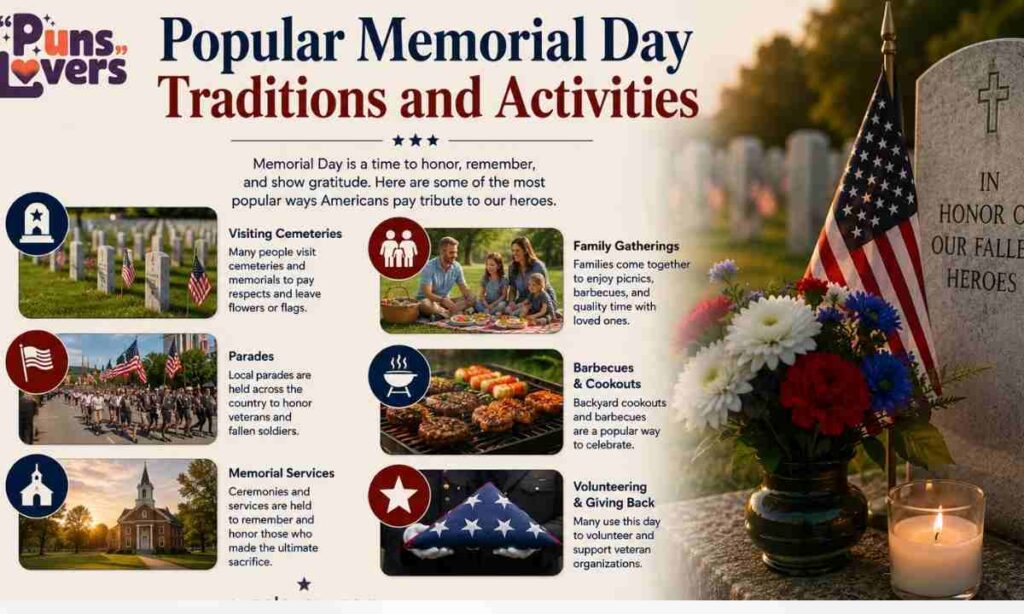
Some of the most meaningful Memorial Day traditions have been practiced for generations. Others are newer but equally heartfelt.
Visiting Military Cemeteries — Families visit the graves of relatives who served, often bringing fresh flowers, small flags, or personal mementos. It is one of the most intimate acts of remembrance possible.
Wearing Red Poppies — Red poppies symbolize remembrance and respect for those who died in service to their country. It was originally inspired by the 1915 poem “In Flanders Fields,” by John McCrae, to honor those who died in WWI. Many Americans wear a paper poppy pinned to their clothing throughout the weekend.
The “Murph” Workout — A modern tradition popular in the CrossFit and military communities. It involves a physically demanding workout named after Navy SEAL Lieutenant Michael P. Murphy, who was killed in action in Afghanistan in 2005. Participants complete it annually as a way to honor sacrifice through personal effort.
Flying the Flag Correctly — Many households display the American flag on Memorial Day. Proper etiquette calls for raising it to half-staff at sunrise, then lifting it to full-staff at noon.
Attending Local Parades — Community parades remain one of the most visible and beloved Memorial Day traditions, bringing together veterans, families, and neighbors in a shared public act of remembrance.
Sharing Family Stories — Perhaps the most powerful tradition of all. Telling children and grandchildren about family members who served — showing old photos, reading letters, speaking names aloud — keeps individual memories alive in a way that no ceremony can fully replace.
If you enjoy exploring the deeper meaning of words and expressions used in everyday communication, you might also find this piece on what “HN” means in text an interesting read about how language carries hidden layers of meaning.
Why Memorial Day Is Still Important Today
In an era of short attention spans and endless distractions, a holiday that asks people to slow down and feel something heavy might seem out of step. But that’s exactly why it matters more now than ever.
Memorial Day fights against forgetting. As the wars of the 20th century grow more distant in living memory, fewer Americans have direct personal connections to those conflicts. The holiday keeps the human cost of war visible when it might otherwise fade into abstraction.
Memorial Day matters for Gold Star families. For families who have lost a loved one in military service, this is one of the most emotionally intense days of the year. Knowing that the country pauses to acknowledge their loss — even briefly — means more than words can express.
Memorial Day reminds us what freedom costs. It’s easy to enjoy rights and liberties without thinking about what it took to secure them. Memorial Day is an annual reminder that those freedoms were not free — they were paid for by real people who chose service over safety.
Memorial Day Meaning for Americans
For most Americans, Memorial Day carries a layered meaning:
- A time to grieve and remember
- A moment to feel national unity and pride
- A chance to teach younger generations about sacrifice
- The unofficial start of summer — a season of warmth, family, and life
- An opportunity to honor people they have personally loved and lost
All of these coexist. A cookout in the backyard and a quiet moment at 3 p.m. are not contradictions — they are two expressions of the same American spirit.
You can explore comprehensive historical information about the holiday’s full evolution at History.com’s dedicated Memorial Day resource, which covers everything from its Civil War origins to modern observances.
Interesting Memorial Day Facts You Probably Didn’t Know
Even people who grew up celebrating Memorial Day may not know some of these lesser-known details:
Freed Black Americans helped start it. One of the most significant early memorial observances was organized in 1865 by formerly enslaved people in Charleston, South Carolina — a fact that often goes untold but speaks volumes about who the holiday’s original spirit was meant to honor.
The original date was May 30 — not a Monday. Before 1971, Memorial Day was always May 30, regardless of what day of the week it fell on. Veterans groups and historians have long argued that fixing it to a Monday — while convenient — disconnected the holiday from its historical date and shifted public focus toward recreation over remembrance.
“Taps” has a painful origin. The haunting bugle call played at military funerals and Memorial Day ceremonies was composed during the Civil War and was played for the first time at a soldier’s burial when a full funeral salute was considered too dangerous near enemy lines. Its 24 notes are among the most emotionally resonant sounds in American culture.
The holiday almost disappeared. In the late 1990s, surveys showed that many young Americans had little awareness of Memorial Day’s true meaning. This alarming finding was part of what pushed Congress to pass the National Moment of Remembrance Act in 2000.
Poppy Day falls the Friday before Memorial Day. Poppy Day in the US is the Friday before Memorial Day. That is the day the VFW officially distributes Buddy Poppies. The small red poppies are hand-made by disabled veterans, and the proceeds support veteran welfare programs.
The Tomb of the Unknown Soldier is guarded 24/7, 365 days a year. Through every storm, every blizzard, every hurricane — the tomb has never been left unguarded since 1937. Memorial Day ceremonies there carry extra weight because of what that continuous, unbroken watch represents.
Meaningful Memorial Day Quotes and Messages

Words can carry the weight of grief when nothing else seems adequate. These are some of the most powerful quotes associated with Memorial Day — spoken by presidents, generals, poets, and ordinary people:
On sacrifice and freedom: “A hero is someone who has given his or her life to something bigger than oneself.” — Joseph Campbell
On remembrance: “How important it is for us to recognize and celebrate our heroes and she-roes.” — Maya Angelou
On the cost of liberty: “The patriot’s blood is the seed of freedom’s tree.” — Thomas Campbell
On continuing their legacy: “Our flag does not fly because the wind moves it. It flies with the last breath of each soldier who died protecting it.” — Unknown
On keeping faith with the fallen: “If ye break faith with us who die, we shall not sleep.” — Lieutenant Colonel John McCrae, “In Flanders Fields”
On what Memorial Day truly asks of us: “The greatest casualty is being forgotten.” — Wilton Williamson Jr., Wounded Warrior Project
What to Say on Memorial Day
Knowing the right words matters. Here’s a simple guide:
| Situation | What to Say |
| Greeting a Gold Star family member | “I’m thinking of [name] today with gratitude” |
| General holiday greeting | “Have a meaningful Memorial Day” |
| To a veteran who is grieving a fallen friend | “I’m honored to remember alongside you” |
| What NOT to say | “Happy Memorial Day” |
| To children | “Today we remember brave people who kept us safe” |
Conclusion
Memorial Day is not just a gateway to summer it is one of the most emotionally honest days on the American calendar. It asks people to hold two things at once: the joy of being alive, and the grief of knowing that others gave up that joy so they could have it. That tension is not a contradiction. It is the whole point.
So the next time the last Monday of May arrives, take one minute at 3 p.m. and stand still. Think of a name any name etched into a headstone somewhere in this country. Let the weight of that life land on you, even briefly. That quiet minute costs nothing, but it means everything to the families who live with that loss every single day.

We are passionate about wordplay and spreading smiles through witty content. Backed by 5 years of experien . PunsLovers.com is your go-to hub for humor.