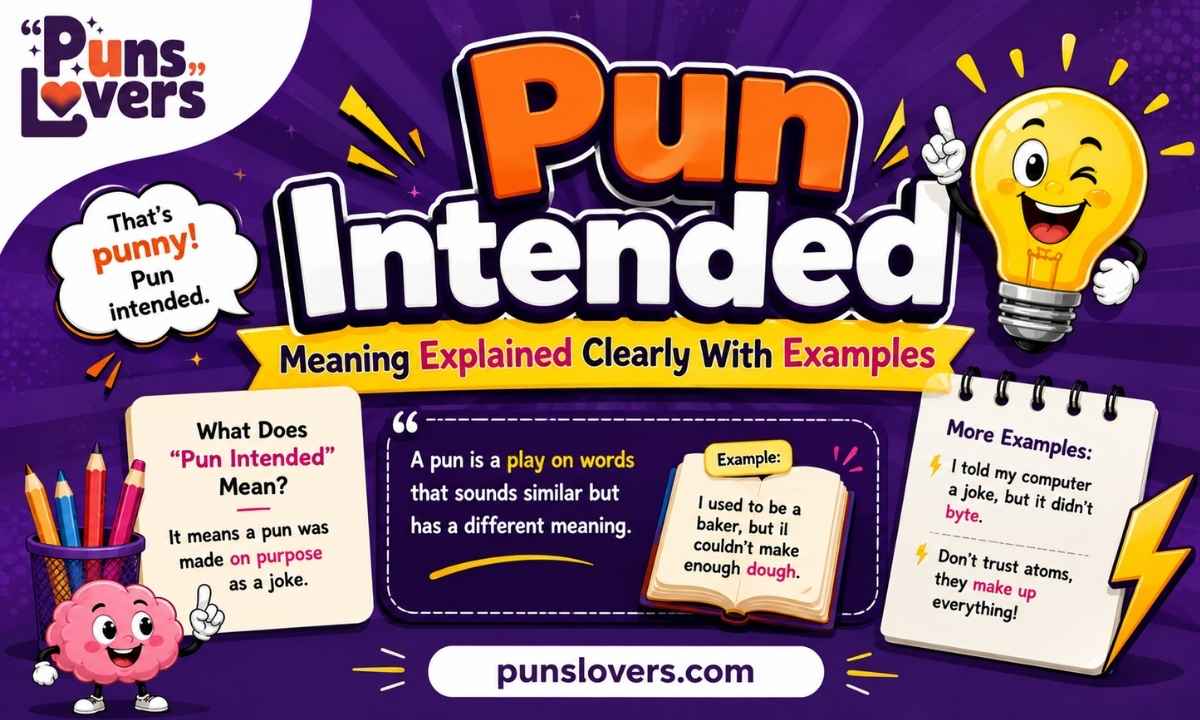
Ever said something clever, then quickly added “pun intended” right after? You’re not alone. This little phrase shows up constantly in conversation, texts, and social media, and it has a very specific job: letting people know a wordplay joke was on purpose. Let’s break down exactly what pun intended meaning covers, how it’s used, and when to reach for it yourself.
It’s a phrase most people pick up naturally, without ever really learning it, and yet it does exactly what it needs to do every single time. By the end of this guide, you’ll have a clear picture of where it comes from, how it works, and how it compares to its close cousin, “no pun intended.”
What Does Pun Intended Meaning Explained Clearly?
In simple terms, “pun intended” is a phrase used right after making a pun to confirm the wordplay was deliberate, not an accident. It’s a quick way of saying, “yes, I meant to do that.”
The phrase has become so common that most English speakers instantly recognize it, even if they’ve never stopped to think about why it exists. It works almost like a small stage direction, letting the listener know exactly how to interpret the sentence that came before it.
Simple Meaning of Pun Intended
At its core, the phrase means “that double meaning was on purpose.” People add it so listeners don’t wonder whether the wordplay was intentional humor or just a coincidence.
- It signals awareness of the joke.
- It invites the listener to smile or groan along with you.
- It keeps the tone light and playful.
This simple three-word phrase does a lot of work in a short space. It shifts a sentence from sounding like an odd word choice into something clearly meant to be funny, which is exactly why it has stuck around in everyday English for so long.
What Is a Pun? Understanding the Meaning of Wordplay
A pun is a joke that uses a word’s multiple meanings, or two words that sound alike, to create a humorous effect. It’s a classic form of wordplay found in everyday speech, writing, and literature, and it’s been part of the English language for hundreds of years.
Puns work because the brain briefly holds two meanings at once, and that overlap is what creates the laugh. Once you understand this basic mechanic, phrases like “pun intended” make a lot more sense.
Puns have been part of the English language for centuries, showing up everywhere from casual conversation to classic literature. Understanding what a pun actually is makes it much easier to spot one in the wild, and to appreciate why someone might feel the need to point it out with a phrase like “pun intended.”
Types of Puns and How They Work
Not all puns are built the same way. Here’s a quick look at the most common types you’ll encounter in everyday speech and writing.
| Pun Type | How It Works | Example |
| Homophonic | Words that sound alike, different meanings | “I’m dying to know why they call it a funny bone.” |
| Homographic | Same spelling, different meanings | “The bandage was wound around the wound.” |
| Compound | Two puns combined in one line | “Two silkworms had a race. It ended in a tie.” |
Knowing these categories helps explain why “pun intended” gets attached so often plenty of everyday words naturally carry double meanings. Once you start recognizing these patterns, you’ll notice that almost any conversation has the raw material for a pun hiding somewhere in it.
Pun Intended Examples That Make the Meaning Clear
Here are a few examples showing exactly how the phrase gets used in real sentences.
- “This bakery really rises to the occasion, pun intended.”
- “The electrician’s work really lights up the room, pun intended.”
- “My gardening hobby has really taken root, pun intended.”
- “That math teacher’s jokes just don’t add up, pun intended.”
- “Our new bike shop business is really picking up speed, pun intended.”
- “The fisherman’s stories always seem to get reeled in, pun intended.”
Each example includes a word with a double meaning, followed by the phrase to confirm it was on purpose. Reading through a few examples in a row also makes it easier to spot the pattern: a normal-sounding sentence, a word doing double duty, then the little confirmation tag at the end.
Pun Intended Example Sentences in Everyday English
The phrase fits naturally into casual, everyday speech.
- “I’ve been saving money like it’s my job, pun intended, since I actually work at a bank.”
- “This new gym really has me pumped up, pun intended.”
- “Our internet plan is lightning fast, pun intended, since we switched to fiber.”
These examples show how “pun intended” slides right into normal conversation without feeling out of place. It rarely needs a big introduction or setup most of the time it just tags along naturally at the end of a sentence someone was already going to say.
Pun Intended in Written English
In writing, “pun intended” often appears in parentheses or set off with commas, right after the pun itself. This helps readers catch the wordplay even if they’re skimming quickly.
- “The bakery’s profits are really rising (pun intended).”
- “Our new mattress line is a real dream come true, pun intended.”
Writers use this format especially in blog posts, marketing copy, and social captions where a visual pause helps the joke land. Brands in particular lean on this trick often, since a well-placed pun with a clear “pun intended” tag can make an ad or headline feel more approachable and fun.
Pun Intended in Spoken English
In spoken conversation, “pun intended” is usually said with a slight pause and a knowing tone, almost like a wink in verbal form. It often gets a small laugh or eye roll from whoever’s listening, which is exactly the reaction it’s going for.
Tone of voice matters a lot here. Said flatly, the phrase can sound almost apologetic, but said with a bit of a smile in your voice, it comes across as confident and self-aware, which is usually the effect people are going for.
No Pun Intended Meaning Explained Simply
“No pun intended” is the opposite phrase. It means the wordplay wasn’t planned, and the speaker just noticed it after the fact. It’s a way of acknowledging an accidental double meaning without taking credit for a clever joke.
This phrase is especially common in more serious conversations, where a speaker wants to avoid sounding like they’re making light of a heavy topic. Adding “no pun intended” helps signal that the humor was accidental, keeping the overall tone respectful.
Pun Intended vs No Pun Intended: What Is the Difference?
Though these two phrases look almost identical, they signal opposite things about a joke. One claims credit for wordplay, while the other disclaims it, and knowing which one to use depends entirely on whether the pun was planned or not.
Pun Intended Meaning and Usage
“Pun intended” is used to own a joke the speaker is confirming they noticed the wordplay and chose it on purpose. It usually follows the pun immediately.
No Pun Intended Meaning and Usage
“No pun intended” is used to distance the speaker from claiming credit for a clever joke. It often appears when a word choice accidentally creates humor in a serious sentence.
Pun Intended vs No Pun Intended: Quick Comparison
| Phrase | Meaning | When It’s Used |
| Pun Intended | The wordplay was deliberate | Right after a planned joke |
| No Pun Intended | The wordplay was accidental | Right after an unplanned double meaning |
No Pun Intended Examples and Example Sentences
- “The stock market really crashed hard this week, no pun intended.”
- “I broke my leg while training for the marathon, no pun intended, but it really set me back.”
- “The bakery went out of business, no pun intended about the dough running out.”
- “The power went out during the storm, no pun intended, and left the whole street dark.”
These examples show a serious or neutral sentence where an unexpected double meaning slipped in. In each case, the speaker likely wasn’t trying to be funny at all, which is exactly why the disclaimer feels necessary.
Why Do People Say “Pun Intended”?
People add this phrase for a few clear reasons, each tied to how puns land in conversation. Understanding these reasons makes it easier to decide when the phrase actually adds something, versus when it might be better left out.
To Make the Joke or Wordplay Clear
Sometimes a pun is subtle enough that listeners might miss it entirely. Adding “pun intended” flags the joke so nobody walks away confused about whether they missed a punchline or just heard an odd sentence.
To Add Humor and Wit
The phrase itself has become part of the joke. Saying it with the right timing can get its own laugh, separate from the pun that came before it, almost like a small bonus punchline tacked onto the end.
To Avoid Confusion
Without the phrase, some sentences could sound like an odd mistake instead of a joke. “Pun intended” clears that up instantly, which is especially helpful in writing, where tone of voice can’t do the job for you.
To Make Conversations More Playful
Using the phrase regularly adds a lighthearted, witty tone to everyday conversation, signaling that the speaker enjoys wordplay. People who use it often tend to be seen as quick-witted, since it shows they’re actively paying attention to the words they choose.
What Does “Pun Intended, Perhaps” Mean?
Adding “perhaps” softens the phrase, giving it a more playful, understated tone. It suggests the speaker is being modest about their own joke, almost teasing the listener into deciding whether it was clever or not. This softer version tends to show up more in writing or scripted dialogue, where a slightly more polished, self-deprecating tone fits the moment.
Can a Pun Be Unintentional?
Yes, absolutely. Language is full of overlapping meanings, so double meanings often slip into sentences by accident. That’s exactly why “no pun intended” exists — to acknowledge those unplanned moments of wordplay. In fact, some of the funniest accidental puns happen precisely because nobody was trying to be clever in the first place.
When Should You Use “Pun Intended”?
Timing matters. The phrase works best right after the pun, while the wordplay is still fresh in the listener’s mind. Waiting too long to add it can make the joke feel like an afterthought rather than a deliberate moment of wit.
Using Pun Intended in Casual Conversations
In everyday chats, the phrase adds a playful touch and usually gets a small laugh or groan from friends and family. It’s one of the easiest ways to bring a bit of humor into an otherwise ordinary conversation without much effort at all.
Using Pun Intended in Social Media and Texts
Online, the phrase is often shortened or paired with emojis, and it works especially well in captions where a pun might otherwise go unnoticed. Hashtags like #punintended have also become common, turning the phrase into its own small piece of internet shorthand.
Using Pun Intended in Formal Writing
In more formal writing, the phrase should be used sparingly, if at all, since overly casual wordplay can sometimes feel out of place in professional documents. A business report or academic paper, for instance, usually calls for a more restrained tone where a pun might distract from the main point.
Is Saying “Pun Intended” Funny, Clever, or Rude?
Most people find the phrase clever rather than rude, since it shows self-awareness about the joke. However, using it too often in a single conversation can start to feel repetitive or try-hard, so a little restraint goes a long way. Like most humor, context and audience play a big role in how the phrase gets received.
Common Mistakes When Using “Pun Intended”
Even a simple phrase like this can be misused in a few common ways. Being aware of these pitfalls helps the phrase land the way it’s meant to, instead of falling flat.
Using It When There Is No Actual Pun
Sometimes people tack on “pun intended” even when there’s no real double meaning, which confuses listeners instead of clarifying the joke. This often happens when someone is reaching for humor without actually landing on a genuine pun first.
Overusing the Phrase
Adding it after every sentence quickly loses its charm and can come across as trying too hard to be funny. Like any recurring joke, it works best in moderation, saved for moments when the pun genuinely deserves the spotlight.
Confusing Puns With Double Meanings
Not every double meaning is technically a pun. Mixing these up can lead to the phrase being used incorrectly in sentences that don’t actually contain wordplay, which weakens the joke rather than strengthening it.
Pun Intended Meaning Explained in Tagalog
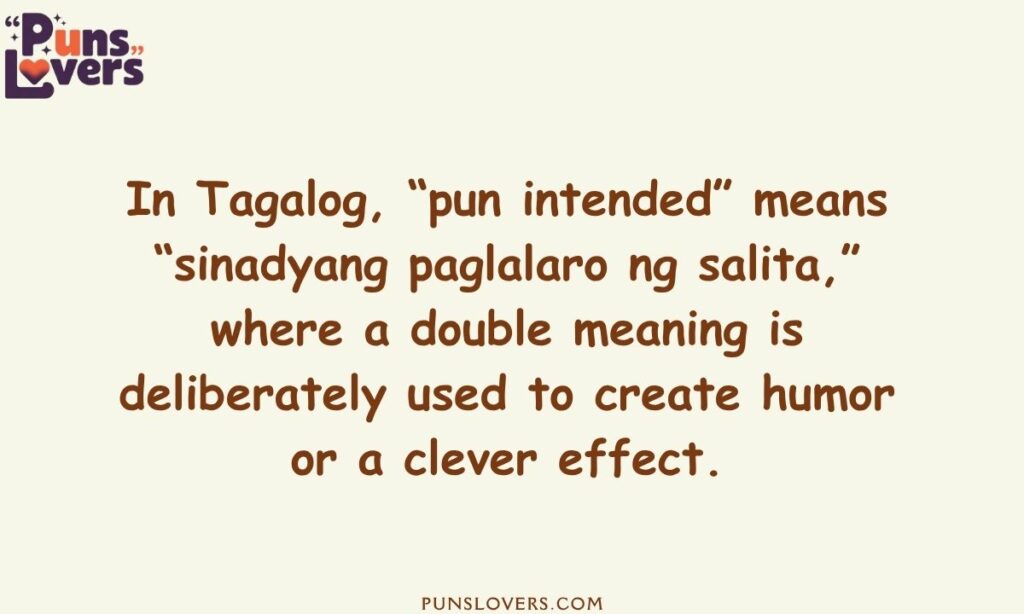
In Tagalog, the concept behind “pun intended” translates roughly to acknowledging a “sadyang katatawanan sa salita,” or intentional wordplay joke. The phrase itself is often simply borrowed directly from English in casual Filipino conversations, especially online, since there isn’t a single widely used Tagalog equivalent that captures the same tone.
Code-switching between English and Tagalog is extremely common in the Philippines, and phrases like “pun intended” often get dropped into a Tagalog sentence exactly as they are in English. This mirrors how many English idioms and expressions get absorbed into everyday Filipino speech without needing a full translation.
Pun Intended Meaning According to Reddit Discussions
Online communities like Reddit often use “pun intended” in a slightly exaggerated, self-aware way, treating it almost like its own punchline. According to Cambridge Dictionary, a pun is a form of humor that uses a word with two meanings, or words that sound the same but have different meanings, for a joking effect. Reddit threads frequently riff on this definition, with users deliberately overusing “pun intended” for comedic effect or turning it into a running joke within a specific comment thread.
Pun-focused communities on Reddit often turn the phrase into a kind of inside joke, where members compete to slip it into increasingly obvious or ridiculous sentences. This kind of playful repetition shows just how flexible the phrase really is, stretching from a simple clarifier into a full running bit depending on the community using it.
If you enjoy this kind of internet-style wordplay, you might also like this collection of hilarious quiz questions and answers for more playful language fun.
Explore Funny Pun Examples Packed With Clever, Simple, and Hilarious Wordplay That Will Make You Laugh
Frequently Asked Questions
What Does Pun Intended Mean in Simple Words?
It means the wordplay or double meaning in a sentence was done on purpose, not by accident. The speaker is basically flagging their own joke so it doesn’t get missed.
What Is an Example of Pun Intended?
“This bakery really rises to the occasion, pun intended” is a clear example, since “rises” plays on baking and success. The phrase confirms that double meaning was chosen deliberately.
What Is a Pun Intended Example Sentence?
“My gardening hobby has really taken root, pun intended” works well, since “taken root” applies to both plants and personal interests. It’s a good template for building your own examples.
What Does No Pun Intended Mean?
It means a double meaning appeared in a sentence by accident, and the speaker wants to clarify it wasn’t a planned joke. It’s often used to keep a serious sentence from sounding unintentionally funny.
What Is an Example of No Pun Intended?
“The stock market really crashed hard this week, no pun intended” shows an unplanned double meaning in a serious sentence. The speaker isn’t trying to make light of the situation.
What Is the Difference Between Pun Intended and No Pun Intended?
“Pun intended” confirms a deliberate joke, while “no pun intended” clarifies that a double meaning was unplanned. Both phrases exist to manage how a listener interprets the wordplay.
Why Do People Say Pun Intended?
People say it to make sure a subtle joke doesn’t go unnoticed, and to add a playful, witty tone to their sentence. It also helps signal that the speaker enjoys wordplay in general.
Can a Pun Be Unintentional?
Yes, since English has so many overlapping meanings, double meanings often appear in speech and writing without any planning at all. That’s exactly the situation “no pun intended” was made for.
Conclusion
“Pun intended” might be a small phrase, but it carries a lot of personality. It turns a simple double meaning into a shared joke between speaker and listener, and that little wink of self-awareness is often what makes it fun in the first place.
Whether you’re chatting with friends, writing a caption, or just noticing an accidental double meaning in your own sentence, this phrase gives you an easy way to acknowledge the wordplay. Use it with a light touch, and it’ll keep doing exactly what it’s meant to do pun intended, of course.

We are passionate about wordplay and spreading smiles through witty content. Backed by 5 years of experien . PunsLovers.com is your go-to hub for humor.


1 thought on “Pun Intended Meaning Explained Clearly With Examples”